Showing posts with label Koi Rama. Show all posts

Sunday, May 4, 2014

Koi Rama - Finished!

I finished this shawl up last night, but didn't block it until this morning.  All last week I worked steadily on the final chart.  Even though I cast on for the large size I only used 3/4 of my yarn, and my shawl ended up a medium.  This just goes to show you how much gauge can influence the finished size of a project.  I used the recommended needle sizes, but I did not do a gauge swatch (I rarely do for shawls).  As long as I like the resulting lace, I keep going, and don't worry that much about the gauge.  I guess the designer knits looser than I do.  I also am not a strenuous blocker.  I pull until I feel resistance, but don't stretch my yarn to within an inch of its life.

I used to be a loose knitter, but I adjusted how I hold my yarn and now I almost always get gauge for commercial patterns.  I am a thrower rather than a picker and I pass the working yarn over my index finger, under the middle finger, over the ring finger and loop it once around the pinkie.  I have found, however, that I almost never match the gauge of independent designers.  At this point I don't even bother trying.  I look at the weight of the yarn and the finished item and pick a needle size that I think is appropriate.  When I look at the specifications for the pattern and compare my needle choice with the designers I can get a sense of whether or not they are a tight or loose knitter.  If I have never knit with the yarn before I will do a gauge swatch, just to see how it knits up, but I don't fully believe the results of gauge swatches.  I use them to get me started with a pattern and make the initial adjustments that I need, but they can't tell the entire story, so I check my gauge after I have knit some portion of the garment, and then if I am happy with the fabric I fine tune my adjustments.  If I don't like the fabric, I will ravel, change the needle size and begin again.  Thankfully, lace knitting has taught me to enjoy the process of knitting, and not just the end product, so I can rip out and begin again without anger or frustration.

Pattern:  Koi Rama by Kitman Figueroa
Yarn:  The Unique Sheep Tinsel Toes in Pisces
Needles:  US 8 (5.0 mm), US 6 (4.0 mm), US 4 (3.5 mm)

Sunday, April 27, 2014

Koi Rama - Chart 3 Done

I finished up chart 3 last night, staying up a bit late to get through it.  It was a bit of a problematic chart.  Early on I missed one of the wrapped stitches and didn't realize it until I was working the wrong side row.  I just did the wrap then and moved on.  And while we're on the topic of wrapped stitches, may I just say that I am not a fan.  I never know how tightly to wrap the stitches, and I find the whole affair fiddly.  I did try using a cable needle, but that was more awkward than passing the stitches back and forth between the needles.  I am glad that I am done with them.  Then two wayward beads inserted themselves into the knitting when I wasn't looking.  I remember feeling them under my fingers while I was knitting, and thinking I needed to slide them down the yarn, but then I got distracted (probably by a cat), and they disappeared.  I thought about them later, and discovered them lurking on the back of the work.  I thought about leaving them there as a silent witness to my inattention, but after I finished the chart I took an awl to them and broke them off the yarn.  To do this I carefully inserted the tip of the awl into the bead being careful not to poke into the yarn, then put the tip of the awl against a cork board and gave the handle of the awl a little wack with my hand.  The beads broke easily.  That is the safest way to get them off, although glass can go flying when you break them, so putting a cloth over the set up is recommended.  I do not recommend using a pair of pliers to break beads off of yarn as this can cause the broken glass to cut into your yarn.  The awl forces the bead apart and sends the sharp edges away from your yarn.

For those keeping track, the story so far.  I started with a 200 g set of yarn from The Unique Sheep.
I started with skein 4, the one on the left.  It was a little heavier than 50 g, 52 g to be exact.  I wasn't sure how far I would get on skein 4 so I threaded 100 beads onto it.  I used size 8 beads.  I am working the large size as I want to use as much of my yarn as possible.  I always hate having leftover yarn.  The bead counts for the large size are as follows:

9 x 8 = 72 beads needed for chart 1
8 x 8 = 64 beads needed for chart 2
7 x 8 + 12 = 68 beads needed for chart 3

I ended up making it to row 3 of chart 2 with skein 4, which included 1 row of beading on chart 2, so I needed the following bead counts on skeins 4 and 3.

Thread 72 + 16 = 88 beads on skein 4
Thread 64 - 16 + 68 = 116 beads on skein 3

Or I would have, if there hadn't been an error in chart 1 - the beads were missing on row 14 and I didn't realize it until I started looking at the beads needed for charts 2 and 3.  In the end I left off the corresponding beads on charts 2 and 3, just so everything would be consistent.

Here is a close up so you can see the butterflies and the fish and the beads I used.  They are an iridescent bead with colors very similar to the colors of the yarn - I went for blending rather than contrast.

Pattern:  Koi Rama by Kitman Figueroa
Yarn:  The Unique Sheep Tinsel Toes in Pisces
Needles:  US 8 (5.0 mm), US 6 (4.0 mm), US 4 (3.5 mm)

Saturday, April 26, 2014

Koi Rama - Chart 2 Done

Even though I wasn't up to knitting lace this past Thursday, I did want to get the next skein prepped for Koi Rama, so I started looking at the next charts to see how many beads I would need to string.  Making notes, and counting, and recounting, and checking my math again, and I kept coming up with a total that was less than what the patten called for.  Then I was looking at the charts again and I noticed a difference between the bead placement on chart 1 and the bead placement on charts 2 and 3.  Uh Oh, I said to myself, it looks like there is an error in the bead placement on chart 1.  I went to Ravelry and checked out some photos of finished shawls.  Sure enough, there should have been beads on row 14 of chart 1, but they were missing from the pattern.  I added the missing beads to my count, and voila!  The number tallied.  But now I was faced with a decision that I was not up to making on Thursday.  I went ahead and threaded enough beads to finish both charts, as written, just in case and then set everything aside.

When I came back to it this morning I had decided to leave out the corresponding beads on charts 2 and 3, just to make everything match.  I switched to skein 3 on row 27 ( row 3 of chart 2).  I used up all of skein 4, and didn't do any transition rows.  I don't do transition rows any more, and with this yarn it really wouldn't be necessary even if I did, the color change is wonderfully subtle.

Pattern:  Koi Rama by Kitman Figueroa
Yarn:  The Unique Sheep Tinsel Toes in Pisces
Needles:  US 8 (5.0 mm), US 6 (4.0 mm), US 4 (3.5 mm)

Tuesday, April 22, 2014

Koi Rama - Chart 1 Done

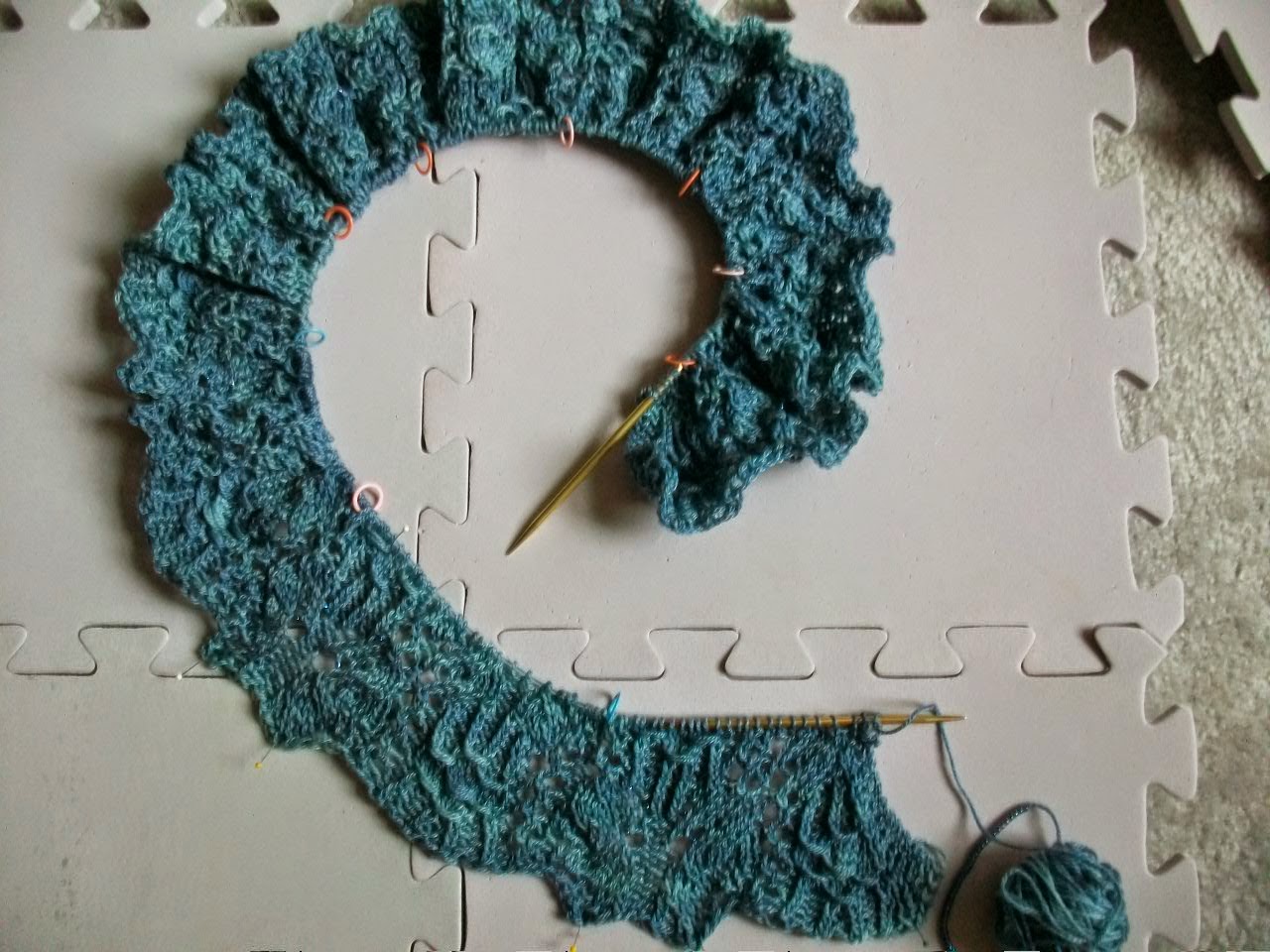
As soon as Scorpius was off the needles and on the blocking mats I cast on Koi Rama.  This shawl is knit from the bottom up so you have to cast on a lot of stitches, and I am doing the large size, so I had to cast on even more.  My usual cast on is the long-tail cast on, but when I have to cast on 330 stitches I go for the knitted cast on.  The advantage of working shawls from the bottom up is that the rows keep getting shorter.

The pattern calls for casting on with US size 9 (5.5 mm) needles, but I didn't have a US size 9 with a long enough cable so I used a US size 8 (5.0 mm).  You then knit one row with the larger needles before switching to US size 6 (4.0 mm) and beginning the lace chart.  As you can see, I am actually using stitch markers to separate the repeats of the pattern, an unusual course of action for me, but this pattern is complex enough that I needed them.

There are suggested bead placements in the pattern, so of course I had to add beads.  Fortunately I had a good match in my extensive bead stash.  The recommended placement method is to pre-string them.  I have used this method before, but it really isn't my preferred method.  First, you have to string enough beads to get through your current cake of yarn.  The stringing is easy.  I use a Japanese Bead Threaders.  They don't tear up your fiber or your fingers the way that the Big Eye needles do.  Second, they don't stay put.  This pattern has you place them on the yarn overs.  I've done this before as well, and I always forget what to do with them when I work the next row.  For this pattern the yarn overs form pairs, so on the first yarn over I pushed the bead to the right side of the yarn over strand and on the second yarn over I pushed the bead to the left side of the yarn over strand.  They do tend to wander a bit while you're knitting the next couple of rows, but they are pretty easy to push back into the spot you want them to be.  When I started this cake of yarn I strung 100 beads, and it looks like I'll have a few to spare.  I'll collect the exact numbers for each yarn cake as I go.

The yarn is Tinsel Toes, from The Unique Sheep, in the color Pisces.  This was the yarn for the most recent Zodiac Club shipment, but the pattern really didn't excite me and the yarn really wanted to be made into Koi Rama.
It is a lovely gradiance set and I am starting with the darkest skein (on the left).

Pattern:  Koi Rama by Kitman Figueroa
Yarn:  The Unique Sheep Tinsel Toes in Pisces
Needles:  US 8 (5.0 mm), US 6 (4.0 mm), US 4 (3.5 mm)